

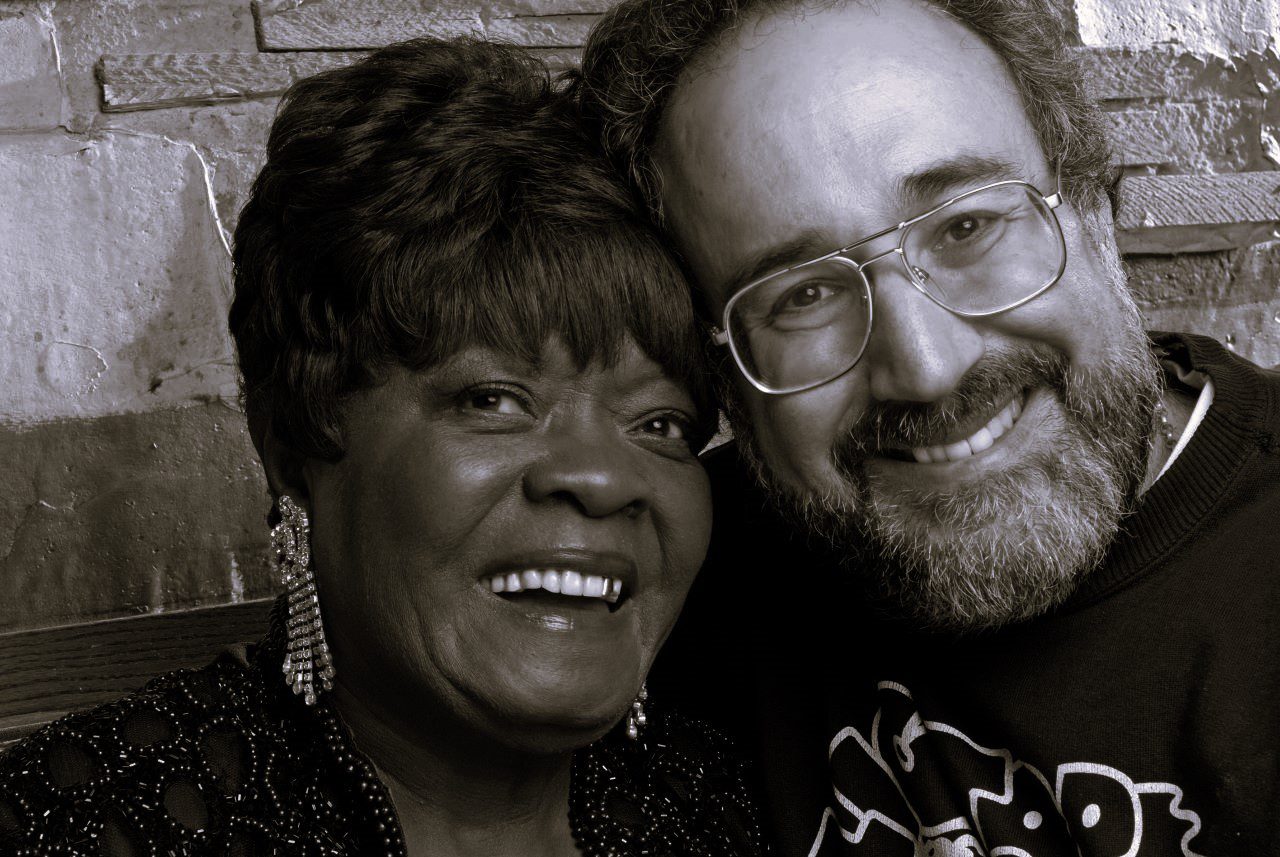
Interview with the founder of Alligator about Koko Taylor
by Matteo Bossi
We talked with Bruce Iglauer four years ago for the 50th Anniversary of Alligator and we recently did it again to celebrate the longstanding relationship with the late Koko Taylor, who put out her first album on Alligator, I Got What It Takes, half a century ago, in 1975. “We worked together for over 35 years both as her label and her management as well. At one point I was her booking agent, but thankfully that didn’t stay with me because I wasn’t very good at it. She welcomed the whole Allligator staff into her home, she made us family, it wasn’t just a business relationship at all. I was there with her right after she wrote I’m A Woman, she couldn’t sing to me over the phone she had do to it in person, I was there when her first husband died and I was there with her when she died. It was a very special relationship”. These are his words, as we start talking about Taylor and the compilation that has just come out, aptly titled Crown Jewels, twelve tracks selected from her extended Alligator catalogue.
When did you first meet Koko? You wrote in your book that it was a night when she was sitting in with Mighty Joe Young.
It was probably 1972, because we put out “I Got What It Takes” in 1975 and by then I had already started booking her. But yes, she was sitting in with Mighty Joe Young and she was working as a house maid, cleaning houses. And not working as a professional singer at all. She didn’t have a band of her own at that time. We were introduced and she came to me and asked me if I could maybe do some booking for her. I was trying to be the booking agent for Hound Dog Taylor and Son Seals so I was in touch with some clubs and festivals. So I said I’d try, but I knew she didn’t have a band or transportation, a van or a vehicle. She took my phone number and she called me up a week or two later and she said, “I just made a down payment for a van and I got a band in rehearsal and here’s who is in the band.” So she was telling me if I would take her seriously she would do what she needed to do to be able to deliver a show. We didn’t talk about records at that time, but potentially to record for me. She was reliable and not expecting me to do this for her. Not everybody is like that, at all. Her husband was going to be her driver and he was…I spoke at his funeral and I said that he would be remembered by the friends, the fans, the family and of course by dozens of state troopers who watched his tail lights disappear into the distance. 100 miles an hour was normal for him!
She had been in Europe at least a couple of times.
Yes, I knew she had been there in 1967 or 68 with Little Walter and the American Folk Blues Festival and at Montreux where she recorded that duet with Muddy. And she did a record in France with Jimmy Rogers and Louis Myers, that would have been a tour that Didier Tricard put together on the Black & Blue label. I was just emaling with him two days ago, we remained friends for all these years. She had an opportunity to record and she took it, I don’t remember the year it was done. But she had no contract after Leonard Chess died.
He passed in 1969.
Yes, before I moved to Chicago. I’ve never met him, and just before he died he sold the company to GRT. After Chess went away there were not a lot of opportunities, blues ceased to be very much part of the mainstream on black radio. There were still blues shows, like Pervis Spann for example, who would play 45s and LPs, but blues was not in the popular mainstream of younger black community. And it was just beginning to become known with white people. When I started Alligator the most active label in Chicago was probably Delmark but they would only release three or four LPs a year. So any opportunity for a recording was exciting for the musicians.
For her first album on Alligator how did you work? You had Sammy Lawhorne and Mighty Joe Young on guitars. Did you choose together the repertoire?
Well, Koko had songs that she di regularly, like Big Boss Man…some were brought to the project by me and other by Koko. Interestingly we rehearsed at Willie Dixon’s place on the South Side, which was close to where Koko lived, but I was so intimidated by Willie that I didn’t consult or talk with him. I was scared, not that he would hurt me, but I was scared that he knew too much and he was quietly laughing at me behind my back. Which may have been true! As far as the band, the only member of her road band that we used was Vince Chappelle on drums. Because Koko had the band she could afford, not necessarily the best…and it was OK for going on the road. Some musicians just don’t like the road. Vince had been with her also in the Sixties and he was the guy that would announce her, “and now the queen of the blues, Kokkoo Taylor!!” and he did it great. Joe was her friend and he was also one of the most reliable rhythm guitar players, he was knowledgeable about chords and how to play rhythm and get funky than her band was. Sammy Lawhorn was and is one of my favorite guitar players ever. But I had to make an arrangement with him. Sammy was an alcoholic and I knew he had to drink some in order to stay focused, so I took him aside and I said you can get a drink but if you drink too much you’re gonna get fired off the session. You have to agree with me that you will drink only in moderation. He agreed and he was always very good at the sessions. He took me seriously because he knew I was such a huge fan. He was a wonderful guitar player, so sensitive. I would go see him at Theresa’s and he would be sitting on his amp and literally fall asleep on it so I could no allow that to happen. At a later session for “From The Heart Of A Woman” he seemed to be fallin’ asleep so I said to him “Sammy, you can’t be drinking on my session”. “Oh, I’m not drunk”, he said, “I got stabbed last night with an ice-pick and after the session I’m gonna go to the hospital”. He lifted up his shirt and showed me the hole. Of course he was not gonna miss the money from the session by going to the hospital first.
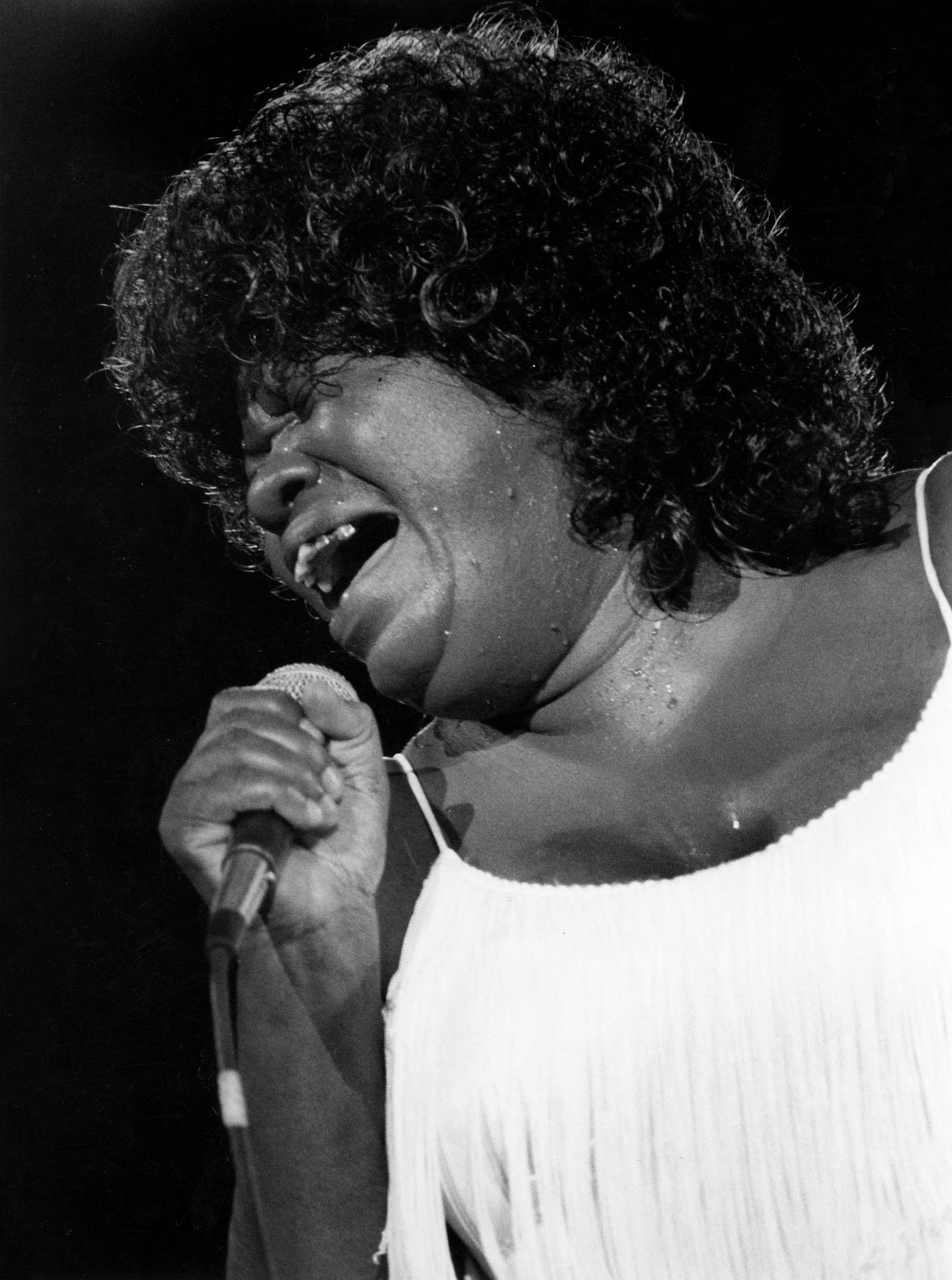
KokoTaylor photo James Fraher
The first record did well and then you went on one at a time.
I had to do it one at a time, I started with almost no money…so I had to sell enough Hound Dog Taylor LPs to record Big Walter Horton, otherwise I could not have made it. Then I had to sell enough Hound Dog and Walter to record Son Seals which was a nearly a disaster, not the recording, but trying to introduce a brand new artist was very hard. With Koko I knew she had a reputation but it wasn’t a big reputation. The first record we did OK, but it was the second record, “The Earthshaker” that really took off. We did “Wang Dang Doodle” of course the groove that she was using then was funkier and slightly slower than the original. I think I brought “Hey Bartender”and I think she knew “You Can Have My Husband” but I might have suggested it, it was an Irma Thomas song. For “I’m A Woman” I was listening to Muddy Waters or Bo Diddley, I’m not sure which, I though there are all these songs about being a tough man in blues, but no anthem for a woman, nothing well known. So I suggested to Koko that she should write an answer song to “I’m A Man/Mannish Boy”. She was excited about that and she called me less than a week later and she said, “come down to the house”. So I drove there, which was 45 minutes away or something like that and she sang it to me in her living room. And it was done, sometimes I suggest a rhyme or something but it was finished. I knew it was gonna be a big deal. We recorded it and it was an important song for her. After the record came out she sang it every night and she was very proud of it.
Maybe she was not a prolific writer but she certainly wrote some great songs over the years.
When we recorded her last album it was a bit of a struggle because her voice was tired, it was a couple of years before she died. I didn’t include songs from that because she didn’t really have a chance to make them part of her repertoire, she did relatively few performances after that. She was in the hospital. At one point she was on a ventilator…we thought she would never come back and then she did. She wasn’t ready to die. She passed in 2009. The first performance after the hospital was for charity, a benefit, she didn’t get paid. It was a charity started by a family she had worked for when she was a housemaid, for people with a health condition, their bones broke very easily. So that what she chosed to do. If Koko had idea in her head, she was gonna do it. She was very determined. She was not well educated, she was not an intellectual, she was country in the best possible way. If she loved you, she loved you completely. If she was angry with you, you knew it immediately. And I love people like this. They’re exactly what they appear to be.
David Lynch passed away earlier this year and Koko had scene in one of his movies, Wild At Heart, what was that like?
It was actually very funny. They contacted us one or two days before they wanted us in California to do this scene. I had to hire a lawyer to represent Koko for the negotiations, because I knew there was gonna be some real money. And literally he was still negotiating a deal while Koko and I drove to the airport. And he made the deal, we flew to California and Angelo Badalamenti, the composer that Lynch liked so much, took us into rehearsals at the hotel. The song was recorded the next day with a bunch of jazz musicians who she’d never known before, Jimmy Heath is playing tenor saxophone, I believe. I can’t remember who the keyboard player is, but he was the leader of the band. So either that day or the next she was singing on film for the scene in which Nicolas Cage and Laura Dern are in the bar dancing. I just remember there was a lot of waiting. She only learned the song the night before but she was ready. It was all so quick. They performed the whole song and they only use a bit of in the movie. She was very excited and determined to do it very well. She took every performance very seriously. She had to do a great job, she understood how important it was. During the break on set I was sitting with David Lynch and he was talking about how they kill the cattle in the stockyards in Kansas City, so he was talking about dead cows, which seemed to be appropriate somehow. He was determined to keep the movie moving forward, he didn’t spend a lot of times with us but he was gracious.
How did you work on Koko’s other records? Was there any other turning point?
We waited a certain amount of time between each record, not so much with the live one, that was her regular show and I didn’t try to influence that with new songs, she did one new song on that, “The Devil’s Gonna Have A Field Day”. I remember when she brought Criss Johnson in for the “From The Heart Of A Woman” sessions, I was really nervous about it, I’ve never met him and I didn’t know what he could do. I knew he was essentially a gospel guitar player, I think at one point I’d seen him with Otis Clay. He was a very big force in how our sound changed, got funkier. He’s an amazing guitar player. I ran into him at Gene Barge’s funeral a few months ago. He plays only in church and in gospel shows. It was very rare for him to play anything but gospel music, except that it was Koko and they were cousins. He turned out to be a wonderful addition to the band, he did a lot of interesting things with the arrangements that I might not have thought of. That session with him and Sammy Lawhorn was great. Sammy grew up in the country, he played with Sonny Boy, Muddy, Junior Wells…Criss was a much more sophisticated musicians, an amazing rhythm guitar player. I had never understood for example that rhythm players would not play all the strings at the same time, they would change the voices to fit the songs. I tried to play guitar a bit but I’m really bad and I’m not being modest. And he also played left handed upside down, it was hard to follow his hands. He did a lot for Koko.
In your book you wrote that Koko used to say to you, “blessed the bridge that carried you across”. Do you feel Alligator is like a bridge?
Well, it’s a bridge between the artist and the potential audience and it doesn’t always work. But when it does you can create a career for an artist that can last their entire life, like it did with Koko. I’m just working on the new Lil’Ed and Blues Imperials album, which I think is the ninth or tenth album I’ve done with them. I’ve met Ed when he was under thirty and now he’s seventy and still playing just like then, actually better than when he was younger. He was working in a car wash. Now he has a house, he’s not rich but he’s financially secure. I try to help musicians if they ask me.
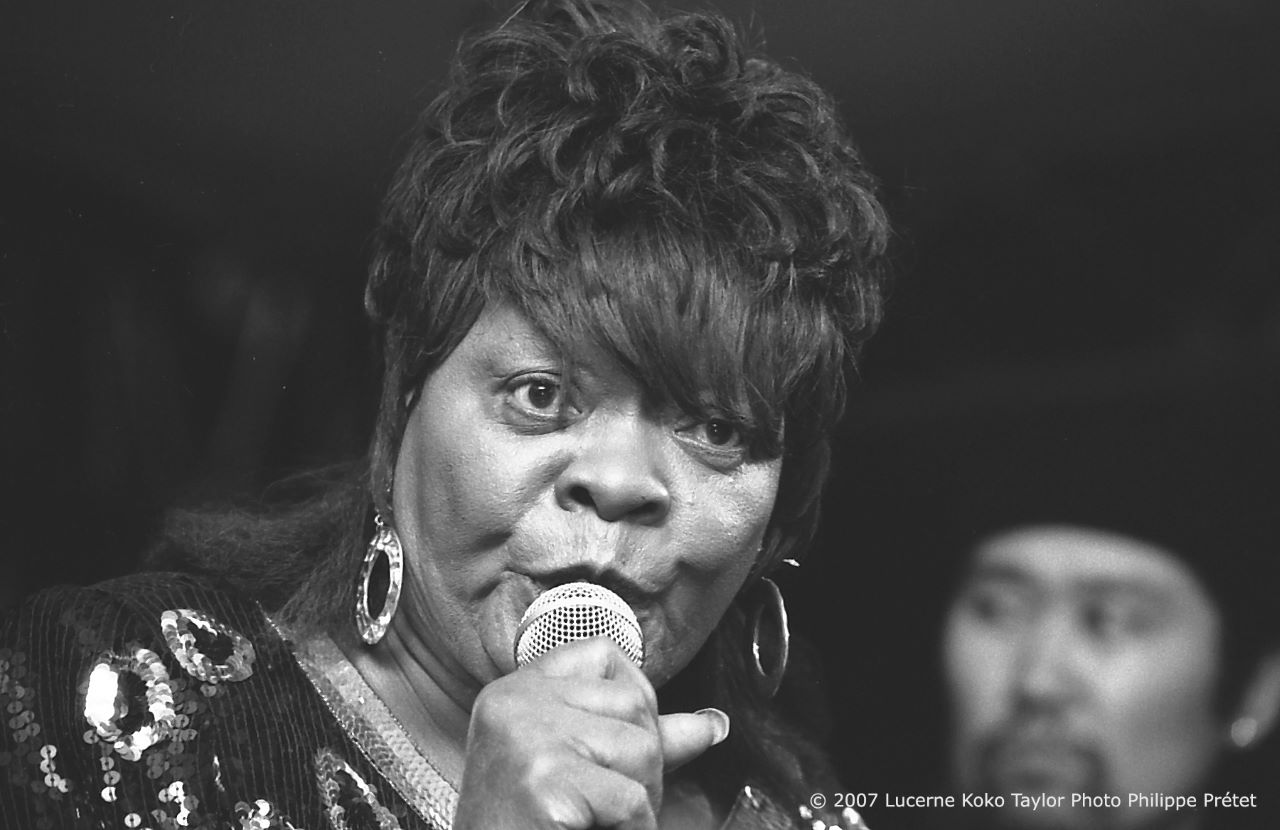
Koko Taylor Lucerne 2007 photo Philippe Prétet
What do you think about Koko’s legacy?
I’ve heard so many people try to imitate her and fail. She was a huge influence on up and coming female singers. She was the icon on what it means to be a blues artist. She was independent. When Koko was happy with the band and the performance she would be celebrating afterwards. If she was unhappy with the band, she would throw me out of the dressing room, close the door, and I could hear words that I’d never heard her use in a normal conversation. She was very tough on the band, she could be their mother but a very strict mother. She knew how to take command, and she would always said to them, “watch my foot”. They have to find her groove and play music the way she felt it. That was their job.
Koko never fired anybody but she could be very rough. Sometimes, how can I put, she said she had a mistaken judgement when she hired some musician…but she didn’t wanna fire them because they became like family to her. She had a wonderful bass player named Jerry Murphy, he was also very loyal to her, like she was his mother. Then Jerry got strung out on drugs but it was only after he began not showing up at gigs that she had to fire him. But she let him stay at her place when he was homeless. I remember one gig, I was not there but they told me, when he had big cut on his face, someone hit him with a knife, and it was because of drugs. But he was a lovely guy. He changed my view of drug addicts. I think we lost track of him. When crack came it was hard, before it was mostly alcohol. Koko could make you feel like you were a member of her family. She did that with Shemekia and she liked her because Shemekia never tried to sound like Koko. She was nice to everybody until she found she could not trust him. So you started in her good graces and you had to work your way to be in her bad graces. She fired me once as her manager on an international flight. And she hired me back about four hours later. It was a really bad four hours.
Is there any project you would have like to do with Koko and never had the chance or the time to do?
I’m thinking. It would have been nice to do an album of duets, men and women. I would have loved to hear Koko singing with Ruth Brown for exemple. I knew her a little bit, Shemekia recorded a song with her. I went to Las Vegas for the recording session and she was delightful. And I think the artists never get the recognition they deserve. Koko one national television that I remember was at the Grammys when they did a blues tribute with B.B. and Albert King, Robert Cray, Dr John, Junior Wells, Willie Dixon, Etta James…you can find it on Youtube. I think Jim Keltner was on drums and Tim Drummond on bass and somebody else. It was very interesting, this is just a side note, they were doing this Tulsa groove, then Robert Cray did his verse and started to play rhythm guitar and suddenly the whole band locked to him and the groove changed. I was there and I could feel it. I’m trying to think if she was part of the very first Soundstage when they paid tribute to Muddy.
She was in the Godfathers and Sons, the Chicago segment of the Scorsese produced documentary films.
Yes, I was upset with that. The creator of the film decided that he wanted to show the connection between blues and hip-hop. The good part of the show was that Koko had a little club at that time and we filmed a jam there one night with a number of artists, Magic Slim, Detroit Junior, Lonnie Brooks…That was real Chicago blues. Those film they could have been something important for the blues, but it was during a period of time when we were about to invade Iraq and they showed them in several nights in a row. If you did not know anything about the blues it was too confusing to follow it, there were different directors and it was really sad for the blues, a missed opportunity, but you can’t spend time mourning about what didn’t work.
There wasn’t any other opportunity to get Koko’s music featured in tv series or movies?
If we’re approached by a tv show or a movie we squeeze them for all the money we can possibly get and then we say yes. But we did not have that opportunity with Koko. I can’t recreate the past. I find it constantly amazing that this thing I create in a one room apartment has lasted so many years. I still work with a lot of the same artists like Lil’ Ed, and like back then, we create the record in rehearsals, all the decisions are taken in rehearsals. The basics tracks of his album we recorded sixteen songs in two days. Then he came back to sing some parts. I have to make records fast I gotta fit them in budget. This is the only way the company makes money.







Comments are closed